Friday, 6 December 2013

Nelson Mandela Through the Years In Pictures (Childhood, Marriage, Prison, etc )

Nelson Mandela Through the Years In Pictures (Childhood, Marriage, Prison, etc )
Nelson Mandela Through the Years
A young Nelson Mandela is seen in this undated photo. (ANC)


Nelson Mandela Through the Years
Nelson Mandela in his youth circa 1950.


Nelson Mandela Through the Years
Nelson Mandela married Winnie Madikizela in June 14, 1958. (Gallo Images/Avusa/Getty Images)


Nelson Mandela Through the Years
South African anti-apartheid activist, revolutionary and politician Nelson Mandela on visit to London in 1962. (Sygma/Corbis)

Nelson Mandela Through the Years
In 1987 political prisoner Nelson Mandela fell ill with early signs of tuberculosis and was hospitalized at Tygerberg Hospital in Cape Town. Protesters and well-wishers gathered outside to show their support for him and the apartheid struggle. (Gallo Images/Oryx/Getty Images)

Nelson Mandela Through the Years
Anti-apartheid leader and African National Congress (ANC) member Nelson Mandela and his wife Winnie raise fists upon Mandela's release from Victor Verster prison, Feb. 11, 1990 in Paarl.(Alexander Joe/AFP/Getty Images)

Nelson Mandela Through the Years
South African anti-apartheid leader and African National Congress (ANC) member Nelson Mandela and Zambian president Kenneth Kaunda wave to the crowd as they arrive at a mass rally of ANC, at Independent Stadium, March 3, 1990, in Lusaka, seat of the exiled ANC. Nelson Mandela, who was released from jail in February, is in Zambia to attend a meeting of ANC National Executive Committee. (Walter Dhladhla/AFP/Getty Images)

Nelson Mandela Through the Years
African National Congress (ANC) President Nelson Mandela raises his fist in the air as he attends an election rally in Mmabatho, South Africa, March 15, 1994. (Walter Dhladhla/AFP/Getty Images)

Nelson Mandela Through the Years
ANC President Nelson Mandela sits next to an election campaign poster as he listens to an official of the ANC in front of some 20,000 supporters at the Soweto stadium in South Africa, April 23, 1994, three days ahead of South Africa's all race national elections. (Walter Dhladhla/AFP/Getty Images)

Nelson Mandela Through the Years
President-Elect Nelson Mandela, left, and President F.W. de klerk stand at attention as they listen to the country's two national anthems outside parliament in Cape Town, May 9, 1994. Mr. Mandela is to be formally inaugurated as the country's first black president. (Greg English/AP Photo)

Nelson Mandela Through the Years
Archbishop Desmond Tutu introduces Nelson Mandela to the crowd at the City Hall, Cape Town, South Africa, May 11, 1994. (Gallo Images/Oryx/Getty Images)

Nelson Mandela Through the Years
South African President Nelson Mandela chips a rock Feb. 10, 1995 in the quarry where he endured hard labor for 12 of his 19 years in the notorious Robben Island prison off the coast of Cape Town. (Guy Tillim/AFP/Getty Images)

Nelson Mandela Through the Years
President Nelson Mandela with his wife Graca Machel during a journey on the Blue Train in October 1997. (Gallo Images/Oryx/Getty Images)

Nelson Mandela Through the Years
From left, South African President Nelson Mandela, U.S. President Bill Clinton, first lady Hillary Rodham Clinton and Graca Machel talk inside the Section B, prison cell No. 5 at the Robben Island, South Africa prison, March 27, 1998. (J. Scott Applewhite-Pool/AP Photo)

Nelson Mandela Through the Years
Former South African President Nelson Mandela lands a "straight left" to the chin of former World Champion Muhammad Ali as South African Special Olympics Athlete Rofhiwa looks on at the Global Youth Summit, hosted by Timothy Shriver, President of Special Olympics, in Dublin, June 21, 2003. (Ray McManus/Corbis)

Nelson Mandela Through the Years
Irish rock star Bono and former South African president Nelson Mandela are pictured after meeting at Mandela's home in Johannesburg, May 25, 2002. Bono and US Treasury Secretary Paul O'Neill are in the country on the second leg of their African tour to highlight the need for development aid to the world's poorest continent. (Juda Ngwenya/AFP/Getty Images)

Nelson Mandela Through the Years
Former South African President Nelson Mandela waves during the Nelson Mandela 46664 World AIDS Day Concert in Johannesburg, South Africa, Dec. 1, 2007. (Schalk van Zuydam/AP Photo)

Nelson Mandela Through the Years
Former South Africa's President Nelson Mandela poses with his grandchildren, at his home in Qunu, South Africa, July 18, 2008. Mandela, the anti-apartheid icon, spend his 90th birthday at home in Qunu with his family, and the whole village is celebrating. (Themba Hadebe-Pool/AP Photo)

Nelson Mandela Through the Years
Former South African President Nelson Mandela, center left, waves next to his wife Graca Machel, center right, as they are driven across the field ahead of the World Cup final soccer match in Johannesburg, South Africa, July 11, 2010. (Daniel Ochoa de Olza/AP Photo)

Nelson Mandela Through the Years
In this photo from Feb. 2, 2013, Nelson Mandela, 95, sits holding his great grandson Zen Manaway, 1, at home in Johannesburg, South Africa. Zen, the youngest in the Mandela family, is traveling in the U.S. with his mother Zaziwe Dlamini-Manaway and his aunt Swati Dlamini, as the sisters promote their new reality TV series "Being Mandela." (Family Photo Courtesy of Being Mandela/AP Photo)

Quotes from Nelson Mandela

Nelson Mandela is sworn in as the first black president of South Africa in 1994 CNN


1. Education is the most powerful weapon which you can use to change the world.
2. When a man is denied the right to live the life he believes in, he has no choice but to become an outlaw.
3. I learned that courage was not the absence of fear, but the triumph over it. The brave man is not he who does not feel afraid, but he who conquers that fear.
4. I am fundamentally an optimist. Whether that comes from nature or nurture, I cannot say. Part of being optimistic is keeping one’s head pointed toward the sun, one’s feet moving forward.
5. There were many dark moments when my faith in humanity was sorely tested, but I would not and could not give myself up to despair. That way lays defeat and death.
6. A good head and good heart are always a formidable combination. But when you add to that a literate tongue or pen, then you have something very special. It always seems impossible until it’s done.
7. For to be free is not merely to cast off one’s chains, but to live in a way that respects and enhances the freedom of others.
8. Resentment is like drinking poison and then hoping it will kill your enemies.
9. There is nothing like returning to a place that remains unchanged to find the ways in which you yourself have altered.
10. I have walked that long road to freedom. I have tried not to falter; I have made missteps along the way. But I have discovered the secret that after climbing a great hill, one only finds that there are many more hills to climb. I have taken a moment here to rest, to steal a view of the glorious vista that surrounds me, to look back on the distance I have come. But I can only rest for a moment, for with freedom come responsibilities, and I dare not linger, for my long walk is not ended.
11. Lead from the back — and let others believe they are in front. I am not a saint, unless you think of a saint as a sinner who keeps on trying.
12. The greatest glory in living lies not in never falling, but in rising every time we fall.
13. There is no passion to be found playing small – in settling for a life that is less than the one you are capable of living.
14. Do not judge me by my successes, judge me by how many times I fell down and got back up again.
15. As I walked out the door toward the gate that would lead to my freedom, I knew if I didn’t leave my bitterness and hatred behind, I’d still be in prison.
16. If you talk to a man in a language he understands, that goes to his head. If you talk to him in his language, that goes to his heart. As I have said, the first thing is to be honest with yourself.
17. You can never have an impact on society if you have not changed yourself… Great peacemakers are all people of integrity, of honesty, but humility. As we let our own light shine, we unconsciously give other people permission to do the same.
18. Where you stand depends on where you sit.
19. Overcoming poverty is not a task of charity, it is an act of justice. Like Slavery and Apartheid, poverty is not natural. It is man-made and it can be overcome and eradicated by the actions of human beings.
20. Sometimes it falls on a generation to be great. YOU can be that great generation. Let your greatness blossom.
21. One of the things I learned when I was negotiating was that until I changed myself, I could not change others.
22. It is said that no one truly knows a nation until one has been inside its jails.
23. A nation should not be judged by how it treats its highest citizens, but its lowest ones.
24. A leader. . .is like a shepherd. He stays behind the flock, letting the most nimble go out ahead, where upon the others follow, not realizing that all along they are being directed from behind.
25. Courage is not the absence of fear — its inspiring others to move beyond it. Appearances matter — and remember to smile.
26. We ask ourselves, who am I to be brilliant, gorgeous, handsome, talented and fabulous? Actually, who are you not to be?
Nelson Mandela, the global statesman who delivered South Africa from the dark days of apartheid, died on Thursday, 5th December 2013 at aged 95. Mr Mandela had suffered from a series of lung infections over the past two years and died at home in the company of his family. His legacy lives on. May his Soul Rest in Perfect Peace ! -
A young Mandela ILoveHistory

Friday, 29 November 2013

What To Think About When Considering A Career Change


Thanks to the advent of social media and the internet it has never been easier to get out there and look for a new job. And as we start to emerge from recession the number of job opportunities and openings are bound to increase.
But moving to a new job is a major decision and should never be taken lightly or in haste. Work plays a huge part in all of our lives, not just in terms of the time we spend in the office but also how we feel about ourselves as individuals.
It never ceases to amaze me how people will look to change jobs on a whim when it should be one of the most important decisions you take in your life. At the same time, there are people who are far too happy to coast when it is clear they are not progressing.
Here are four factors worth considering before you apply for that new job.

1) Is the grass always greener?
Sometimes people decide to apply for a new job because they are feeling sorry for themselves or a little bit frustrated. But acting on a whim is always going to be a mistake. Before you do anything you should take a step back and ask yourself how you currently feel about your job, and what the alternatives are. Perhaps you enjoy it much more than you realise and maybe the alternatives on offer aren’t as great as they seem. It makes no sense in going through the hassle of a move if it is eventually going to make you feel unhappy.

2) Is there a long-term plan?
Not all of us want to take over the world and we all don’t have to be incredibly ambitious and driven. However, I would expect anyone who works for me to have a long-term career plan. They often say that if you’re standing still you’re also going backwards. Staying in a comfort zone and not challenging yourself leads to inertia and eventually boredom. You need to make sure that the company you work for offers the right kind of opportunities to develop and grow as an employee. Are there courses you will be able to take, is there scope to take on more responsibilities? If the company is not giving you the chance to grow then I would consider looking elsewhere.

3) Are you appreciated?
The worst bosses are the ones who do not value their staff and have no regard for what they bring to the business. Of course, money is an important part of the equation, but you also need to ask if your efforts are being appreciated and your ideas are being properly recognised. If the answer is no then maybe the time has come to look for a new challenge.

4) What does my boss think about me?
I would expect any manager to be speaking to their staff at least once every six months to a year. These chats give both sides a chance to talk about your input into the firm and what things can be done to improve performance. These one-on-ones should also be a chance to find out how your manager feels about you as an individual and where your future lies within the company. If you are being earmarked for a promotion it might change your mind about looking for new opportunities. On the other hand, if your prospects aren’t looking good, it might be the spur you need to move on to pastures new.

I always advise people to treat a job move in the same way I would treat an investment - with careful analysis and diligence. After you have looked at these four factors, you will have a much better idea of whether staying or leaving is the right decision to take.

Just How Much Valuable Time Do You Waste In A Day?


The pressures on the workplace and the pace of life in the modern world has meant that time has become a vitally important commodity in all of our lives.
One of the best things about the wonders of modern communication is that we are all able to do much more with our time than ever before. Instant information is now available at the touch of a button and we can communicate with one another at any time and in any place. The amount of data available to us means information has become much easier to source.
But the internet has also meant that it has become even harder to focus on the task in hand because there are so many distractions in the workplace.
I always attempt to extract as much value as possible from each and every working day. But it’s still important for all of us to sit down and work out exactly how many hours we waste during the day on the kind of distractions and tasks that are not key to the performance of the company.
It’s a great idea to take a step back and work out just how much wasted time there is. I guarantee most of us would be amazed and more than a little shocked how many hours actually go to waste when you start to add it all up.
Of course, we all need to have downtime and it would be wrong and ultimately counter-productive to expect people to spend all of their time working without any kind of break. If you put people under relentless pressure then sooner or later their work and their productivity will suffer.
A happy workforce rather than one that is stressed and constantly working under relentless pressure will not only be more productive, but will also be more reliable and stable. Once you get into situations where employees are not happy in work then you are bound to encounter problems with stress, ill health and high levels of staff turnover.
The key to good time management is discipline. An inventory of the working day should look at how much time is spent on meetings and tasks that don’t actually add to the company’s performance or are productive.
Try to be as honest as possible and take a logical look at each meeting. Ask yourself what the aim of the meeting is and what targets have been reached. It is far too easy to fall into the trap of holding meetings out of habit; when you go down that route they can quickly become nothing more than talking shops with no discernible aim.
Personal discipline and planning is vital and one of the best tools at your disposal is the office diary. By being organised and planning ahead on daily and a weekly basis you can save yourself plenty of time and effort.
Good time management is really not that difficult to achieve and is one of the easiest things you can do to improve your own personal performance. Even with all of the many distractions in the modern office there really should be no excuses for any kind of time wasting.

Deciding Between Two Job Offers


Job offers can sometimes be like buses and come along in pairs.When people are trying to find a new job then they will go through the process of updating their CV and checking all the usual places for possible openings. That kind of approach is bound to attract interest. And of course, if you are good at what you do then word will get around and you could find yourself with more than one offer on the table.
Even though the UK is still recovering from the recession, we in the recruitment sector are starting to see real signs of a return to growth in employment, and many firms are looking to take on staff.
If you are in the position of having to make a choice between job opportunities then it should be viewed in a positive way. The key is to make the most of that situation.
Of course, the temptation will always be to go down the route of making a decision based on the money on offer. There is nothing wrong with that and if one firm is offering substantially more than the other then it can be an indication that they are the ones with the ambition, drive and financial clout.
But money should not always be the sole driver in the decision making process. Choosing a new job and a new employer is also about your long-term goals, and just as importantly, your personal happiness. Remember you could be handsomely rewarded but be stuck in a job with no prospects, and this isn't a situation you want to be in.
I would always advise people to take a step back before making a decision so you have a chance to think logically - and crucially, so you can find out as much as you can about the companies involved.
You need to see if a company matches your ambitions and principles and whether it is the kind of business you want entrust your future career with. Try and talk to people in the business and check out your prospective employees on the internet. You may even want to speak to recruitment consultants in that sector - often they will know all about what different companies are like. Knowledge will give you the power to make the right choices.
Company culture is one of the most important factors to take into account. Unlike your salary, this is not something which can be negotiated - it is already set in stone. Think about when you went in for your interviews, or if you were shown around the office. Which company made you feel more comfortable? Which one had an environment where you would enjoy your work and flourish?
Remember to also consider your personal situation. You might have an incredibly tempting job offer but you need to take into account the impact it is likely to have on your loved ones and your personal life, in terms of the demands and possible commute. We all have to make sacrifices but there is a crucial work-life balance to be struck.
Most people have a long-term career plan, and you would want a role which corresponds with this. You need to make sure that there will be a chance to build on your skills and to develop in the role. Successful people should always be looking to keep moving forward; there is no point in taking a job which will be a dead end.
If you feel you are being rushed into a decision, this may make your mind up for you. A good company will realise that moving jobs can be a major life-changing decision and give you time to consider your options. If they want you badly enough, they will be prepared to wait.

Thursday, 14 November 2013

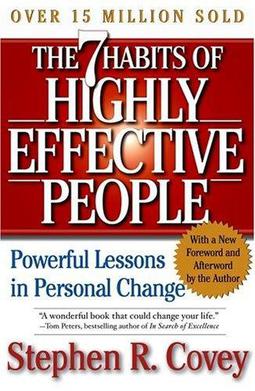
The Seven Habits of Highly Effective People- OVERVIEW

File:The 7 Habits of Highly Effective People.jpg

The book first introduces the concept of Paradigm Shift and prepares the reader for a change in mindset. It helps the reader understand that there exists a different perspective, a viewpoint that may be different from his or her own and asserts that two people can see the same thing and yet differ with each other. Once the reader is prepared for this, it introduces the seven habits, in a proper order.
Each chapter is dedicated to one of the habits, which are represented by the following imperatives:

Independence

The First Three Habits surround moving from dependence to independence (i.e., self-mastery):
  • Habit 1: Be Proactive
Take initiative in life by realizing that your decisions (and how they align with life's principles) are the primary determining factor for effectiveness in your life. Take responsibility for your choices and the consequences that follow.
  • Habit 2: Begin with the End in Mind
Self-discover and clarify your deeply important character values and life goals. Envision the ideal characteristics for each of your various roles and relationships in life.
  • Habit 3: Put First Things First
A manager must manage his own person. Personally. And managers should implement activities that aim to reach the second habit. Covey says that rule two is the mental creation; rule three is the physical creation.

Interdependence

The next three have to do with Interdependence (i.e., working with others):
  • Habit 4: Think Win-Win
Genuinely strive for mutually beneficial solutions or agreements in your relationships. Value and respect people by understanding a "win" for all is ultimately a better long-term resolution than if only one person in the situation had got his way.
  • Habit 5: Seek First to Understand, Then to be Understood
Use empathic listening to be genuinely influenced by a person, which compels them to reciprocate the listening and take an open mind to being influenced by you. This creates an atmosphere of caring, and positive problem solving.
  • Habit 6: Synergize
Combine the strengths of people through positive teamwork, so as to achieve goals no one person could have done alone.

Continuous Improvement

The final habit is that of continuous improvement in both the personal and interpersonal spheres of influence.
  • Habit 7: Sharpen the Saw
Balance and renew your resources, energy, and health to create a sustainable, long-term, effective lifestyle. It primarily emphasizes exercise for physical renewal, prayer (meditation, yoga, etc.) and good reading for mental renewal. It also mentions service to society for spiritual renewal.

Wednesday, 6 November 2013

How to Stop Being Overly Jealous, 10 solid points

Do you find yourself getting nagging feelings of jealousy when your partner is talking to other girls?Relationships: How to Stop Being Overly Jealous
Do you worry that you’re smothering the relationship with your fears? To stop being an overly-jealous girlfriend and start being a dream girl, follow these instructions.
1. Give your partner space
If you’ve been dogging his footsteps, confronting him with accusations, stalking his social media profiles, or exhibiting any other desperate behavior, your first order of business is to back off. Take a few deep breaths, detach, and play it cool for a while.
Find opportunities to be with friends, go to an event you’ve been interested in, and turn him down for at least one get-together.
Be very careful not to act vindictive about this, the point isn’t to punish him, give him the cold shoulder, or manipulate him into begging for forgiveness, but to give the both of you a break so you can blow off a little steam, get some perspective, and hopefully save the relationship.
2. Learn to feel good about yourself
Most feelings of jealousy come from being insecure and thinking that someone else can make your partner happier or bring more to the table. Remember that your partner chose you, not anyone else.
Stop obsessing over your weight, height, or looks, your constant negativity is draining for you and your partner both. Worse yet, an overactive attitude of insecurity can drive people away, become a self-fulfilling prophecy that drives you deeper into the hole of fear and self-neglect.
Accept yourself as you are. Your partner is with you for a reason and obviously finds you attractive, but even if he weren’t and didn’t, you should never let anyone else’s opinion define or validate yours.
3. Deal with past hurts
Most people have them – and many let them spill over into new relationships by either re-enacting the same unhealthy dynamic over and over again or by looking at their wonderful new partners with a skeptical eye.
If necessary, learn how to cope with emotional pain so that you can feel better about yourself and be able to see your current relationship for what it really is.
4. Learn what it means to have a healthy relationship
Whether you’re new to the game or have been at it for years, it’s not always easy to know what a relationship is supposed to be and feel like. Many people don’t grow up with good examples of healthy relationships among their friends, family, or even parents.
What’s worse, having one awful relationship can completely throw off your sense of balance and self-trust, making you second-guess your every move for years to follow.
5. Reassess your current relationship
Once you’ve done some soul-searching and have a clearer perspective on things, it’s time to look at your relationship with a fresh eye.
Do your jealousy, doubt, and fear stem from your own issues with self-worth… or is that something you’ve been telling yourself to justify your partner’s unsatisfactory behavior?
Even if you haven’t been as stable a girlfriend as you should be, that doesn’t mean you should overlook or write off your partner’s transgressions to over-correct for your own feelings of guilt.
It’s always possible that your out-of-control feelings were the result of trying to suppress your own gut instincts – or, at the very least, that you both have played a hand in making the relationship what it is today.
6. Breathe new life into the relationship
Before you can do any in-depth work on yourself or as a couple, you need to do damage control on your strained relationship. Start by striking a healthy balance between giving your partner space and increasing the quality of your time together.
Pursue your own interests in a meaningful, enriching way: after all, part of what attracts people to one another is mystery, and if you spend all your time checking in on your partner with calls, texts, emails, and Facebook posts, there can hardly be any intrigue left in what you do.
Split your time more evenly between your partner and your friends and allow your partner to do the same. Rediscover your interest in a former passion or, if necessary, find a new hobby that will make your non-romantic time more meaningful.
Then, when you have both remembered what it’s like to miss one another, improve your time together by going on a vacation or staycation, trying something new like taking a partner dance class, or lightening the mood by being playful and maintaining the romance.
7. Build your communication
This is something the two of you both need to work on together; many relationship woes could be cured, if not avoided altogether, if couples simply learned how to truly and effectively communicate with one another. A big part of communicating effectively is knowing how to broach an unpleasant topic without putting your partner on the defensive (or, worse yet, the offensive).
Start by curbing your accusations: learn to state what you feel (ex. “I feel afraid when you stay out late and don’t tell me where you are or how long you’ll be there”) instead of what you fear (“I’m worried you’re cheating on me”), which can be come off like a slap in the face.
Be honest about your thoughts and concerns while you’re having them instead of stockpiling them for later and letting them explode one day out of the blue.
8. Learn to trust
Trust issues can make you go crazy. Ask yourself who it is you really mistrust: your partner, your partner’s friends… or yourself?
Coming to the realization that you still don’t trust yourself in love or that you’re simply threatened by other girls is a good thing, both stem from the same issue, can be worked on, and are totally within your control. Learn how to trust your partner again for his and your sake both.
He didn’t text you back? Big deal. Obsessing over things like this will only come across as annoying; if you are laid back and don’t expect instantaneous replies to everything, etc, he will not get irritated.
Don’t call him to see if he’s still there – take a deep breath and let it go. He will reply when he can.
Don’t ask him to stop going certain places. Part of jealousy is the desire to control others, and by giving him freedom, you show that you trust him and make him more likely to respect you.
Don’t write a blank check of trust. If you are genuinely concerned about something, do not be afraid to (gently) broach the topic.
Mention that it makes you feel uncomfortable when he talks to certain girls, or tell him honestly about a behavior he has that bothers you. Don’t overreact or make accusations. Simply state how you feel and, if he respects that, he will try to work it out.
If your partner simply isn’t trustworthy, it’s his turn to roll up his sleeves and match some of the hard work you’ve been putting into the relationship. If he can’t or won’t do it, dump him and start looking for someone who will.
9. Be an awesome girlfriend
Okay, so you’ve managed to salvage the relationship and heal the damage that has been done. Focus on being positive and making the relationship work. The right type of relationship needs communication, trust and prayer.
10. Be Born Again
Fear God and keep his commandments, for God will bring every work into judgement, including every secret things, whether good or evil.

LONGEST BRIDGES IN THE WORLD, THIRD MAINLAND BRIDGE still 7th Find out about others

Architecture has never failed to inspire me, in fact, I thought about it as a career once. This particular list follows ten of the world’s longest bridges. The mere structures are something to admire. Building these huge structures must have been a great deal of pain for the workers nonetheless, they stand mighty as ever. For your information, six of these longest bridges are located in China and three of them were constructed in the United States of America. This list has been compiled to let bridges from all over the world be a part of it. I hope this list proves informative. Enjoy the read!

10. INCHEON BRIDGE

Incheon Bridge - Ten Longest Bridges around the World
The bridge is located in South Korea. It was completed in the year 2009 in October. The bridge covers a distance of around 2.3 kilometers. The bridge was constructed with extreme difficulties considering the structure of the bridge and the construction. It took a long time to complete the structure. The bridge serves as a link between Songdo and Incheon International Airport. I say that this is quite an attractive way to lead foreigners to the main city. It looks beautiful too.

9. WEST GATE BRIDGE

KONICA MINOLTA DIGITAL CAMERA
This is a steel box girder cable-stayed bridge in Melbourne, Australia. The bridge covers the Yarra River. This particular bridge serves as an important link between the inner city and the industrial suburbs and the city of Geelong. The bridge is 58 meters above the water and is around 2.582 kilometers. The bridge is the third longest bridge in Australia behind the Houghton Highway and the Hornibrook Bridge. The Sydney Bridge is half its size. The bridge has a total of five lanes in each direction. It was originally supposed to be a tolled bridge but that changed in 1985.

8. KING FAHD CAUSEWAY

King Fahad - Ten Longest Bridges around the World
This bridge is named after the King of Saudi Arabia, his highness, King Fahad. The bridge has four lanes and is a total of 8 kilometers long. The bridge was completed in the year 1986 after a total construction period of fifteen years. The construction cost around $1.2 billion. The bridge holds a significant importance in terms of trade and commerce between Bahrain and Saudi Arabia. I particularly like the curve in the middle; it is simple yet quite awesome; your opinions?

7. THIRD MAINLAND BRIDGE

Third Mainland Bridge - Ten Longest Bridges around the World
The third mainland bridge is the longest bridge that connects Lagos Island, Lagos, Nigeria to the mainland. There are a total of three bridges serving the same purpose and the names of the other two are Eko and Carter. This bridge is the longest one in Africa. It was built by Julius Berger Nigeria PLC and opened by President Ibrahim Babangida in the year 1990. It is around 11.8 kilometers in length. There were reports that the bridge vibrates viciously and the matter was given urgent attention. There are no tolls on this bridge and it serves vehicular traffic.

6. RIO-NITEROI BRIDGE

Rio - Ten Longest Bridges around the World
This bridge is also referred to as President Costa e Silva Bridge and is a box girder bridge. It is located at the Guanabara Bay in Rio de Janeiro, Brazil. It connects the city of Rio to the municipality of Niteroi. If you consider the southern hemisphere, it is the longest pre-stressed concrete bridge. It is the sixth longest bridge in the world and from 1974 to 1985 it was only second to Lake Pontchartrain Causeway (discussed ahead). It is a total of 13.2 kilometers long.

5. PENANG BRIDGE

Penang Bridge - Ten Longest Bridges around the World
This is a dual carriageway toll bridge and it connects George Town (Island of Penang) and Seberang Prai (Mainland Malaysia). It is also linked with the North-South Expressway. The bridge was opened for traffic in the year 1985 and is around 13.5 kilometers long. It is the fourth-largest bridge in South-East Asia and the longest one in Malaysia. It was designed by Professor Chin Fung Kee, who is a well-known civil engineer in the region. The bridge handles a daily capacity of 65,000 vehicle every day and can handle around 85,000 vehicles in total.

4. VASCO DA GAMA

Vasco Da Gama Bridge - Ten Longest Bridges around the World
This is a cable-stayed bridge and is constructed over the Tagus River near Lisbon. Lisbon is the capital of Portugal if anyone is wondering. This is considered to be the longest bridge in entire Europe and covers a distance of 17.2 kilometers. The purpose behind the bridge was to reduce the traffic on the other bridge in Lisbon. The construction for this bridge began in 1995 and was completed three years after in the year 1998. The speed limit on the bridge is around 120 km/h which I think is pretty appropriate and it has six road lanes.

3. MANCHAC SWAMP BRIDGE

Lake - Ten Longest Bridges around the World
This particular bridge is located in Louisiana. This comes in close to the Lake Pontchartain Causeway, also in Louisiana and discussed ahead. The bridge is around 36.60 kilometers long. The construction of Manchac Swamp Bridge was completed in the year 1970. The interstate 55 rides over the Manchac Swamp with the help of this bridge in Louisiana. This particular bridge is considered to be the busiest in the United States.

2. LAKE PONTCHARTRAIN CAUSEWAY

Pontchartrain - Ten Longest Bridges around the World
Lake Pontchartrain Causeway is located in Southern Louisiana in the United States. The bridge is around 38.4 kilometers long. This is considered to be one of the oldest bridges in the world because it dates back to the nineteenth century when it was first built. Around 9,500 pilings of concrete serve as strong support for the bridge. This bridge links Metairie to Mandeville. It should also be known that since its construction, the bridge was struck by barges on three different occasions causing significant damage.

1. BANG NA EXPRESSWAY

Bang Na expressway takes the first spot. The bridge is situated in Bangkok, Thailand. It has a total of six lanes and is around 54 kilometers long. It is considered to be the longest bridge in the entire world. The construction of the bridge was completed somewhere in March in the year 2000, after long years of construction. The bridge required a total of 1,800,000 cubic meters of concrete. The bridge links Chalerm Maha Nakhoon to Bang Pakong today. These were some of the longest bridges from around the world. Your opinions are welcome, please let us know if we missed any

Bang Na Expressway - Ten Longest Bridges around the World

Guide For You Guys On How To Please Your Partners In Relationship (MUST READ)


You get a call from your friend, who invites you to hang out with the guys on Saturday night. An old college buddy is in town and will be joining you. You are excited to go. However, your girlfriend has a class until 10pm on Friday, so Saturday is your only date night together. You senses that your significant other will not be happy about this, but you also are entitled to a night with the guys.
However, you forget to tell her about your plans until 3pm that Saturday, while she is excitedly proposing a few things you could do that evening.
What happens next is totally predictable. Your woman gets pissed, you argue, she hangs up and calls her girlfriend to complain. You feel surprised and disappointed at how upset she got, and feel resentful. You feel trapped by this relationship and doubtful that this woman is the right one. The right woman would be supportive and want you to have a life, right? While she feels upset that she now has no plans for the evening, and feels that you don’t actually care about spending time with her becuase you don’t take her into consideration when making choices.
Men often complain about how they wish their women wouldn’t get so upset about everything. Well, do they get upset about everything? Hopefully, upon brief reflection, the answer is no. It’s time to look at the types of actions and conversations that make her upset, like the scenario above, to see if there is something you might to do change that.
As an aside, if the answer is yes, it is possible that the guy is living with a truly unstable person. Guys, if your woman suffers from a diagnosable mental illness or personality disorder, you will have a different type of work to do.
But for the rest of you, healthy women will react emotionally when you bring up certain subjects. Here are three steps to reducing the drama and increasing your sense of freedom in your relationship:
1) Learn to expect a reaction—When it’s cloudy and humid, you don’t put on your suede jacket and curse mother nature for screwing you over when it starts to rain, but this is what many men do in relationships with women. Your fear about her reactivity AND your resulting denial about the possibilities that she will be upset, compel you to behave in provocative ways. In fact, she is often responding more to what you have consciously or unconsciously done to avoid upsetting her, then what you were afraid might upset her in the first place. In this way, you create more of what you say you don’t want.
Bring an umbrella. Learn to expect a reaction anytime you change what has become an expected pattern of interacting or unspoken agreement between you. For example:
  • You usually spend Friday nights with her and suddenly you can’t
  • You need to take more time for yourself
  • You suddenly become less attentive to her for any variety of good reasons
If any of the above take place, there’s a good possibility (unless you are with a very mature person) that she will be upset. If you’ve been with your partner for a while, you can get a good sense of what types of things upset her. If you have a hunch that what you need to do or say will bring it on, prepare for it. This will make it much easier for the both of you.
2) Make room for the wave—A fire that has no fuel will extinguish itself. Do not feed the fire by arguing with her about her feelings or perspective. You don’t have to take insults or jabs, but if you can stay calm and allow her upset to be, it will subside. If you are truly not trying to hurt her, then you can feel compassion for her hurt feelings , but you don’t have to believe that you caused them. Your job is not to take it on, fix it or make it better but rather, allow the wave to break on the shore.
It also helps to remember that she is not upset because she is controlling and manipulative, although her behavior certainly might be. She is upset because she loves you and wants to spend time with you, and doesn’t know how else to manage her vulnerability and disappointment.
3) Show her that you are in the relationship. Your woman will move through her reaction very quickly if you demonstrate your care by taking her feelings into consideration. Prepare ahead of time! “Hey listen, Saturday night I’m going to meet with the guys, but next weekend I would love to take you to that place you like by the water.” A communiqué like that can lead to a disappointed sigh instead of a rant, and offers an excitement about the future and a feeling of being cared for that minimizes hurt.
It’s pretty simple. She just wants to know that you care about her feelings, about spending time with her, and that you are not abandoning or taking advantage of her. Of course, anything you promise you must follow through with in order to earn or keep her trust.
If you follow these three steps regularly, a sane woman will respect you, and in turn become increasingly reasonable in response to your requests. And you will see that you can have your freedom and the relationship too. A good woman who loves you really wants you to be happy, as your happiness contributes greatly to hers.

Tuesday, 22 October 2013

Jonathan And The Politics Of (S)election by Reuben Abati july 2010

 
The politics of zoning which has now become a vehicle of intrigue for the professional political class may end up as one of such scandals that could further widen the existing divisions within the country. President Goodluck Jonathan has a personal responsibility to ensure that he does not become a pawn or the architect of an unfolding subterfuge which could in the long run damage his administration’s interests. There are three clear issues involved in the arguments and counter-arguments about zoning as currently constructed. To the small circle of Jonathan’s political strategists (consultants?), it is un-Nigerian, and unadvisable for Jonathan to be President for a year, to organize a Presidential election only to hand over power and office to another person when he, Jonathan is neither sick nor uninterested. So, although Jonathan himself has not issued any categorical statement, his promoters are busy making a case for his presidency. In the process, they have cast the word “opportunism” in a new light, they have given desperation a new name, and the main victim even if they do not realise it now, is president Goodluck Jonathan himself who has unwittingly allowed the golden opportunity of his Presidency to be reduced to endless talks about 2011 and his personal ambition.
All those lofty promises he made when he assumed office have now become less important; his presidency is no longer focusing on electoral reform and integrity, not on the Niger Delta crisis, not on how to rescue the economy or the power sector, but more on how Jonathan can remain in power. The only obstacle that could stand in Jonathan’s path is the reported zoning formula in the Constitution of the Peoples Democratic Party in section 7(2) (c ) thereof which talks specifically about rotation and zoning of party and public elective offices…at all levels. It is this clause that the Jonathan consultants, driven by their own selfish interests and expediency want to circumvent in response to the insistence by certain sections of the North that the North to which the presidency was zoned in 2007 is yet to complete its two terms in office due to President Yar’Adua’s sudden death. They offer no compelling reason other than the fact of Jonathan’s incumbency (one year is not enough for him to make a difference!) and his ethnicity (the South South should be allowed to have it.) Unwittingly, those who claim to be opposing zoning are actually making a case for it only as long as it stands to the benefit of their kinsman or sponsors. But who says each zone must have two terms in the Presidential office compulsorily?
In an earlier piece on this subject, titled “Rotational Presidency and the “core North?”, (The Guardian, April 18 ) I had decried the use of the rotation principle to compromise merit or ability, and the tendency to assume that elected public officials necessarily carry the banner for group interests. This latter point is now fully on display and it presents 2011 as a big threat to Nigerian unity. In the last month alone, Governors of the South South have met to endorse Goodluck Jonathan as the only candidate for Presidency in 2011. The South East Governors were even more brazen: they resolved that nobody in their region must seek to become president or vice president in 2011. In the North, the Governors are divided, while some of the youth and other political stakeholders (Katsina Stakeholders Forum, Arewa Consultative Forum) are up in arms threatening that if the North is not allowed to continue from where late President Yar’Adua left off, there will be great trouble ahead. Some elements have served notice that they will be most willing to foment that trouble. Meanwhile, some Niger Delta militants have also threatened that the next President must be Jonathan or no one else. Thus, the ground seems to have been prepared for violence either before or after the 2011 elections. It is instructive that the group interests that have so far been expressed have all been about Jonathan’s ambition.
The intriguers are already conducting the next Presidential election, without PDP party primaries, and completely in spite of the opposition and the Nigerian voter. They want to select a President for us and they are threatening that we have no choice in the matter. The real scandal is how the unfolding electoral process has been reduced to how best to achieve their target. The decision of the National Assembly to change the order of elections (this was not an existing problem as such), placing National Assembly and Presidential elections first is deliberately calculated to achieve the Jonathan for president goal. Once Jonathan and the PDP win the Presidential and the National Assembly elections, the calculation is that the hands of the electorate will be tied, as very few communities would like to be shut out of power at the centre by voting for another political party. And to be sure that the Governors do not disappoint Jonathan, the PDP chair, Okwesilieze Nwodo is already flying the kite that the PDP Constitution will be amended to stop political appointees from being automatic delegates. It is a shame that President Jonathan will allow himself to be used in this manner. While pretending for the most part to be aloof, he ruined his own case this week, when he disclosed in Uganda that he intends to run an election that will not produce any litigation.

It is not his duty to run elections; that is the responsibility of INEC, and he is definitely not in a position to predict a priori that there will be no litigations because “there should be no reason for people to go to court”. Of course, there will be reasons for litigation, beginning with the current attempt to manipulate the legal framework for the elections. President Jonathan in seeking to become President in 2011 must present his candidacy on the platform of actual performance; he must go through due process within and outside the PDP; and he must do everything to subject himself to the rules. The most important feature of a democratic election is the right and power of the people to choose. He must defend that, because the emergent chaos ridicules the electoral process.
It is being argued in some quarters that all of this is a PDP affair, and that in no way does the argument about zoning preclude other political parties from fielding candidates of their choice. In principle, may be. But the practical reality is that the campaign for a Jonathan candidature is being conducted in such a way as to discourage any other persons from stepping forward as a Presidential candidate. The Nigerian Presidency is ultra-powerful and too many likely strong aspirants have so much that they cannot afford to risk; to challenge an incumbent President or Governor is to risk all forms of victimization including being kidnapped before the elections! The various Governors who are either choosing or rejecting Jonathan for 2011 are not doing so only as members of the PDP; they pretend to be speaking for the Nigerian people. Such arrogance which discounts the electorate can only take the country backwards.
The PDP must respect the rules of internal democracy in choosing its Presidential candidate, and it will be wrong to present its choice as a national decision that is binding on all and sundry. If Jonathan must be President, this must be determined in a free and fair manner, even within the party. Donald Duke in a famous statement that is now being reproduced widely has exposed the role that Governors play in the rigging of elections. It is these same Governors who are now insisting that Jonathan must be President in 2011. Only about eight Governors opposed the plan in the north. Attahiru Jega, the INEC Chairman has warned Resident Electoral Commissioners to stay away from the Governors, but how does he hope to enforce that directive? In better organized countries, Duke’s expose would have raised the level of debate and awareness, rather it has ended up as a matter for side-talk and needless jokes: a general indictment of all of us.
The urgent task before civil society is to resist every attempt by the PDP and other politicians to rig the 2011 elections before they actually take place. Already, a credible voters’ register is non-existent and to produce one in a hurry, the country has to provide N72 billion by August 11, an amount that has now suddenly gone up to N74 billion within a week. Is the computer error alluded to by Professor Jega due to changes in the exchange rate? It is like old times all over again; nothing has changed, except the personnel involved (even that is debatable).