At a time when Nigeria’s President Goodluck Jonathan was visiting China and American President Barak Obama was rounding off his tour of selected African countries, excluding Nigeria, a new book on the economy “Emerging Africa: How the Global Economy’s last frontiers Can Prosper” was released.
The book by Kingsley Moghalu, a Deputy Governor at the Central Bank of Nigeria highlights major causes of African underdevelopment from what he called “failure to develop, articulate, internalise and propagandise a world view.”
When it comes to image-building, a national leader must rise up and project the dignity of his country as a nation to be reckoned with in global politics without being too overzealous or confrontational like late Muammar Ghaddafi of Libya, Saddam Hussein of Iraq and Roberts Mugabe of Zimbabwe. Apart from the undisclosed politics behind the Chinese tour, President Jonathan, who led a multi-sectoral high-powered delegation comprising influential cabinet members, chieftains of industries, governors and politicians to the Asian superpower, also met and invited top executives of several Chinese conglomerates to initiate fresh investments in Nigeria.
At the end of the tour, Jonathan and his Chinese counterpart, Xi Jinping, presided over the signing of five agreements to boost financial, trade, economic, technical and cultural relations that could expand Nigeria’s domestic manufacturing capacity.
The questions on many lips are whether Nigeria is now tilting more towards Asian tigers rather than its traditional allies in the west. Moghalu’s book points out that the idea of socialism in Asia and capitalism in the West do not really matter as most countries practice different types of capitalism. He noted that state capitalism is practiced in China; crony capitalism in Russia and to some extent, Nigeria; welfare capitalism in Europe and entrepreneurial capitalism is practiced in United States.
An African country like Nigeria the author insisted must develop its clear worldview based on fundamental understanding of globalisation that will enable it to identify and protect its interests. He also warns African leaders against turning their countries to a destination of consumers of the products of globalisation.
Nigeria as the most populous country in Africa is a strategic partner to both America and China who are recognised as military and economic superpowers. A recent report in The Guardian of London disclosed that “China's GDP per capita was $9,100, whereas the US boasted a figure of $48,900. There is also an extreme contrast in the respective current account balance - the US has the world's largest deficit burden, while China has the world's greatest budget surplus
In its series of exclusive interviews with top diplomats in Nigeria, the Economic Confidential magazine published interviews with US Ambassador to Nigeria, Terrence P. Mc Culley and his Chinese counterpart, Ambassador Deng Boqing in November and December 2012 respectively.
The two top diplomats in the separate interviews agreed that Nigeria has enormous internal and huge regional market for foreign investors. They also admit that one of Nigeria’s most important resources, outside oil and gas, is its energetic, dynamic and diverse people who have remained together despite speaking over 250 languages by different ethnic groups.
While Amb. McCulley explained that U.S. development assistance to Nigeria exceeds $600 million with more than $5 billion in U.S. investment, the Chinese Ambassador told the same magazine that the accumulated investment from China exceed US$10 billion while its non-financial direct investment was $8.7bn as at December 2012.
Surprisingly while Nigeria is the fifth largest crude oil supplier to USA, its crude export to China is relatively lower, which only constitutes 1% to 2% of Nigeria’s total crude export. Meanwhile, Nigeria is the fourth largest trade partner and the second largest export market for China in Africa. In 2011 Nigerian farmers exported 1.1million metric ton of Cassava chips to China.
The United States supports Nigeria’s national priorities, especially the national security. Apart from supporting the health sector in containing malaria, eradicating polio, and helping millions of Nigerians living with HIV/AIDS, through USAID, the American government has an agric-sector program called MARKETS, which supports farmers needing technical assistance to improve crop yield. It is also committed to assisting Nigeria’s efforts to reform the power generation and hydrocarbon sectors.
On the other side, China’s wide range investment covers sectors such as petroleum, free trade zone, iron and steel, agriculture, manufacturing, pharmacy and mining. It has offered to establish three petroleum refineries in Bayelsa, Kogi and Lagos states and is committed other projects include: railway rehabilitation, power generation, telecommunications projects as well as the provision of houses in Nigeria
Ambassador McCulley added that “Nigeria is a country blessed with both abundant human and natural resources, and the United States seeks partnership not dependency; we seek to build capacity not undermine local initiatives.”
The Chinese Ambassador stated that “China has been an active player in economic globalization and integrated itself with the rest of the world with an open attitude, strengthened exchanges and cooperation
While America is deeply involved in democratic or political processes in many countries, China is more concern with business interests, especially in developing countries. As the second largest economy in the world with the foreign exchange reserve reaching US$ 3 trillion, China has enormous capacity to invest outside its shore. Its increasing investment in Africa is influenced by the reluctance of traditional economic partners such as US, Europe to invest in the continent due to their debt crises.
Nigeria should not only look towards the East or the West alone, it should also create an enabling environment to attract genuine investors devoid of diplomatic rhetoric and political grandstanding. It should also encourage more export of non-oil items from Nigeria, especially agriculture products. The government should explore pragmatic means of turning Nigeria into a major manufacturing zone in Africa.
As Moghalu recommends in his book, the major essentials should be infrastructure, power sector and education with certain conditions and appropriate economic policies to protect national resources and so that Nigeria or Africa is not the ‘last frontier’ for economic exploitations.
Yushau A. Shuaib

Monday, 12 August 2013

Wednesday, 7 August 2013
Why Does ASUU “Always” Go on Strike? By Chijioke Uwasomba
Strike is an organised work stoppage by a body of workers to enforce compliance with demands made on an employer or a group of employers. It is usually a form of protest to force recalcitrant employers to respect the value of labour and accord the latter its rightful place taking into consideration the historical exploitative relationship between labour and capital. In organisations or countries where the principle of collective bargaining is not respected by the employers of labour, the tendency for workers to employ the strike option is very rife. Workers with deep class consciousness and a strong capacity to understand the intriguing manipulations of their employers always exercise their democratic right to fight industrial injustice and dictatorship.
The implication of the above is that the character of states and the nature of employers determine the frequency of work stoppages in a country or in an industry. Experience has shown that societies that are under-developed with an accompanying irresponsible leadership go through all kinds of strikes and industrial crises with their deleterious consequences on the people. This is because, as usual, the ultimate sufferers of these strikes and industrial conflicts are the ordinary people and other victims of the society including the striking workers. Apparently, because of the hypocritical nature of the society the striking workers who ought to deserve the sympathy of the public at all levels become derided and dismissed as agents of destabilisation. In most cases, the issues that would have led to the strike are ignored by commentators who in their exasperation would want the workers to go back to work. Some do not even want to know “who is right or wrong”. All they want is industrial peace.
Quite a lot of people have responded to the on-going strike of the Academic Staff Union of Universities (ASUU). There are three broad categories of people: Those who are in support of the union; those who are opposed to the strike and even strikes in general and those who are playing the Ostrich game. This piece is meant for all the three categories of people. It is true that strikes by their nature are disruptive and that the university lecturers’ strikes have been too frequent. The immediate question is: Why does ASUU always embark on strike?
In answering this question, it will be important to look at the whole gamut of ASUU/FGN relationship over the years since the coming into being of ASUU. ASUU grew out of the Nigerian Association of University Teachers (NAUT) which was formed in 1965. Those who formed ASUU in 1978 felt that NAUT was more like a “middle class fraternity” which did not have the much needed vigour and orientation suitable for the development of Nigeria’s university system in particular and education in general. Nigeria’s post-colonial state had been hijacked by the Military and allied forces who mismanaged the oil boom of the period. The freedoms of the people had been eroded; education at all levels was not getting the required attention; the oil boom, instead of catalyzing the development of the country became ironically a source of under-development and real curse to the nation. It was in the midst of these contradictions and disabling environment that ASUU emerged as an intellectual force to challenge the powers-that-be and offer a credible alternative for our country.
Universities by their nature are democratic institutions hence they are opposed to any manner of imposition either from within or without. The 1978 Uthman Mohammed Commission Report which took away the disciplinary functions of the Governing Councils of Universities provided a litmus test for ASUU. This was because the government of the period in question used the report as a basis to direct some University Governing Councils to dismiss certain members of staff from their posts without giving them fair hearing. In 1980, ASUU declared a Trade Dispute with the Shagari government, making the issue of autonomy an important matter.
ASUU also fought Shagari’s government following Justice Balonwu’s Visitation Panel Report which had directed the Council of the University of Lagos to remove six senior members of the academic staff from their jobs. Given the nature of its mandate, ASUU fought the federal government under Alhaji Shehu Shagari in 1980 and 1981 on issues bordering on funding, salaries, autonomy and academic freedom, brain-drain, the survival of the university system in particular and the direction of the country in general.
Throughout the Military era, ASUU waged a lot of struggles revolving around conditions of service; funding; university authority/academic freedom; the defence of the right to education; broad national issues such as the anti-military struggles; actions against privatisation, SAP and other neo-liberal policies of the government including the World Bank’s attempts to take over the Nigerian University system through its loan under the regime of Babangida.
It should be recalled that ASUU had battled the Buhari/Idiagbon regime’s policy of retrenchment of workers and freezing of wages; gave support to the Nigerian Medical Association (NMA) and the National Association of Resident Doctors (NARD) when they went on their patriotic strike to rescue the deteriorating health services in Nigeria in 1984. ASUU, through strikes, also supported the Nigerian Labour Congress (NLC) and the National Association of Nigerian Students (NANS) to protest the brutal murder of the Ahmadu Bello University (ABU) students by Mobile Policemen in 1986. Again, in 1987 and 1988 the Union was in the trenches. The Union fought the illegal dismissal of its president, Dr. Festus Iyayi and others in 1987. It participated fully in the 1988 general strikes occasioned by the effects of the Structural Adjustment Programme (SAP) which the Babangida government had imposed on the country.
The earlier Elongated University Salary Scale (EUSS) which the government was to implement was abandoned. ASUU was banned but the academics organised themselves under the platform of Universities Lecturers Association (ULA) and it was under this platform that the anti-World Bank Conference to resist the Babangida regime’s attempt to obtain the $120 million loan from the World Bank was held at OAU, Ile-Ife, in 1990.
The failure of the FGN in 1991 to negotiate with the union led to the 1992 strike which was declared on May 14, 1992 but was suspended a week after in deference to an IAP order that the strike should be immediately suspended. Although the IAP ruling compelled both parties to the negotiating table, the government did not resume the negotiation and this pushed ASUU into resuming its strike on July 20, 1992. ASUU was again banned for the second time on August 23, 1992, but when the government failed in all its tricks to break the strike, it appointed the Owelle Chikelu team to negotiate with ASUU. It was this negotiation with a “banned” union that produced the 1992 agreement on October 3, 1992, which Prof. Nwabueze, the erudite scholar and lawyer, in his legal sophistry described as “an agreement of imperfect obligation”. This agreement, among other things provided for a periodic review of every three years.
The Abacha dictatorship presented a greater challenge to ASUU because of the former’s brutal and tough undemocratic credentials and no wonder ASUU opted to join other patriotic forces to fight to end Military rule. In 1994 ASUU went on strike demanding from the government of Abacha: a re-negotiation of the agreement; the re-instatement of over eighty lecturers sacked at the University of Abuja by the then Vice-Chancellor, Prof. Isa Mohammed and the de-annulment of the June 12, 1993 elections ostensibly won by Chief M.K.O. Abiola.
Another strike was declared in 1996 by ASUU to press its demand for the re-negotiation of the 1992 agreement and the re-instatement of the UNI ABUJA sacked academics. This strike lasted for six months. When the strike was suspended, the Abacha government set up the Prof. Umaru Shehu-led Negotiating Team. The government wanted individual Councils of Universities to negotiate with the individual branches of ASUU as part of its decentralization of negotiations. This was met with stiff resistance leading the Abacha government into sacking some ASUU leaders including the then National President of ASUU, Prof. Asisi Abobie of UNN through a letter from the National Universities Commission (NUC) to their Vice-Chancellors.
But the Abdulsalami’s regime, as part of its efforts to gain legitimacy, through its Minister of Education, Chief Ola-Iya Oni made overtures to ASUU and re-instatated ASUU leaders who were unjustly sacked by the Abacha junta for their involvement in the 1996 strike and those earlier dismissed in 1984 through Decree 17 of 1984. On May 25, 1999 the government signed an agreement on percentage increases in the allowances of academics. This agreement was “without prejudice to a comprehensive negotiation at a future date” between the two parties. The Obasanjo regime after much pressures agreed to set up its Negotiating Team led by Prof. Ayo Banjo and the negotiations began on August 28, 2000. The Agreement was to be signed in December 2001. The FGN did not sign the Agreement as Dr. Babalola Borisade who replaced Prof. Tunde Adeniran as Minister of Education prevented the Federal Government’s Team from signing the Agreement. ASUU rejected Borisade’s moves and resumed its suspended strike. This forced the government to resume negotiations and the subsequent signing of the Agreement on June 30, 2001.
The Government of Obasanjo did not implement the 2001 agreement, prompting ASUU to embark on another strike on December 29, 2002. Obasanjo had wanted to cancel the central bargaining process and to introduce school fees in the university system. He also wanted to take a loan of $68 million from the World Bank to implement a World Bank-sponsored Nigerian Universities Innovation Project (NUSIP). William Saint, the World Bank anchor man was everywhere in Nigeria campaigning for the implementation of NUSIP. The strike was suspended in June 2003 on the orders of the IAP. The ding-dong between the FGN and ASUU continued until December 14, 2006, when the then Minister of Education, Mrs. Obiageli Ezekwesili on behalf of the FGN inaugurated the FGN/ASUU Re-negotiating Committee under the leadership of Deacon Gamaliel Onosode to re-negotiate the 2001 Agreement which had been due for re-negotiation since June 2004. The re-negotiation which started on January 23, 2007 was concluded in January 2009. After the grueling two years of negotiation, Onosode said he had not the mandate of his principal to sign the Agreement. This position forced ASUU into another round of strike for four months leading to the signing of the Agreement under Ya’radua.
It is instructive to note that the 2009 Agreement which took many years of struggles to come into being is the basis of the current industrial action as many aspects of the Agreement are yet to be implemented even though the Agreement had been due for re-negotiation since January 1, 2012. Those who blame ASUU for the frequency of strikes in the university system ought to understand that the constant punctuations experienced in the system are caused by the irresponsibility of the successive governments in Nigeria. From 1978 to date, successive governments have not demonstrated commitment to education and Nigeria’s development as can be seen in their willingness to run after and implement ill-digested programmes foisted on them by their international masters that do not have relevance to the needs and aspirations of the people of our country.
Government willingly enters into agreements with workers after many strikes only to abandon the implementation half way. Government must own up to its responsibility by being sincere with the citizenry at all levels. Government officials who are inebriated with power should weigh the consequences of their utterances. The reported dismissive claim of the Minister of Labour and Productivity, Mr. Emeka Wogu to the effect that the 2009 Agreement between ASUU and the FGN, is unimplementable, if it is true has the capacity of deepening the face-off. Government officials like Wogu and the NUC Secretary, Prof. Julius Okojie who fawningly and ingratiatingly engage in bizarre displays with a view to currying favours from their boss, are liabilities to the government they serve. Agents like them have made our universities a hot bed of industrial conflicts. Respect to agreements genuinely entered into by government with workers in the university system and elsewhere will definitely guarantee industrial peace and harmony.
Uwasomba is of the Department of English,
Obafemi Awolowo University,
Ile-Ife
The implication of the above is that the character of states and the nature of employers determine the frequency of work stoppages in a country or in an industry. Experience has shown that societies that are under-developed with an accompanying irresponsible leadership go through all kinds of strikes and industrial crises with their deleterious consequences on the people. This is because, as usual, the ultimate sufferers of these strikes and industrial conflicts are the ordinary people and other victims of the society including the striking workers. Apparently, because of the hypocritical nature of the society the striking workers who ought to deserve the sympathy of the public at all levels become derided and dismissed as agents of destabilisation. In most cases, the issues that would have led to the strike are ignored by commentators who in their exasperation would want the workers to go back to work. Some do not even want to know “who is right or wrong”. All they want is industrial peace.
Quite a lot of people have responded to the on-going strike of the Academic Staff Union of Universities (ASUU). There are three broad categories of people: Those who are in support of the union; those who are opposed to the strike and even strikes in general and those who are playing the Ostrich game. This piece is meant for all the three categories of people. It is true that strikes by their nature are disruptive and that the university lecturers’ strikes have been too frequent. The immediate question is: Why does ASUU always embark on strike?
In answering this question, it will be important to look at the whole gamut of ASUU/FGN relationship over the years since the coming into being of ASUU. ASUU grew out of the Nigerian Association of University Teachers (NAUT) which was formed in 1965. Those who formed ASUU in 1978 felt that NAUT was more like a “middle class fraternity” which did not have the much needed vigour and orientation suitable for the development of Nigeria’s university system in particular and education in general. Nigeria’s post-colonial state had been hijacked by the Military and allied forces who mismanaged the oil boom of the period. The freedoms of the people had been eroded; education at all levels was not getting the required attention; the oil boom, instead of catalyzing the development of the country became ironically a source of under-development and real curse to the nation. It was in the midst of these contradictions and disabling environment that ASUU emerged as an intellectual force to challenge the powers-that-be and offer a credible alternative for our country.
Universities by their nature are democratic institutions hence they are opposed to any manner of imposition either from within or without. The 1978 Uthman Mohammed Commission Report which took away the disciplinary functions of the Governing Councils of Universities provided a litmus test for ASUU. This was because the government of the period in question used the report as a basis to direct some University Governing Councils to dismiss certain members of staff from their posts without giving them fair hearing. In 1980, ASUU declared a Trade Dispute with the Shagari government, making the issue of autonomy an important matter.
ASUU also fought Shagari’s government following Justice Balonwu’s Visitation Panel Report which had directed the Council of the University of Lagos to remove six senior members of the academic staff from their jobs. Given the nature of its mandate, ASUU fought the federal government under Alhaji Shehu Shagari in 1980 and 1981 on issues bordering on funding, salaries, autonomy and academic freedom, brain-drain, the survival of the university system in particular and the direction of the country in general.
Throughout the Military era, ASUU waged a lot of struggles revolving around conditions of service; funding; university authority/academic freedom; the defence of the right to education; broad national issues such as the anti-military struggles; actions against privatisation, SAP and other neo-liberal policies of the government including the World Bank’s attempts to take over the Nigerian University system through its loan under the regime of Babangida.
It should be recalled that ASUU had battled the Buhari/Idiagbon regime’s policy of retrenchment of workers and freezing of wages; gave support to the Nigerian Medical Association (NMA) and the National Association of Resident Doctors (NARD) when they went on their patriotic strike to rescue the deteriorating health services in Nigeria in 1984. ASUU, through strikes, also supported the Nigerian Labour Congress (NLC) and the National Association of Nigerian Students (NANS) to protest the brutal murder of the Ahmadu Bello University (ABU) students by Mobile Policemen in 1986. Again, in 1987 and 1988 the Union was in the trenches. The Union fought the illegal dismissal of its president, Dr. Festus Iyayi and others in 1987. It participated fully in the 1988 general strikes occasioned by the effects of the Structural Adjustment Programme (SAP) which the Babangida government had imposed on the country.
The earlier Elongated University Salary Scale (EUSS) which the government was to implement was abandoned. ASUU was banned but the academics organised themselves under the platform of Universities Lecturers Association (ULA) and it was under this platform that the anti-World Bank Conference to resist the Babangida regime’s attempt to obtain the $120 million loan from the World Bank was held at OAU, Ile-Ife, in 1990.
The failure of the FGN in 1991 to negotiate with the union led to the 1992 strike which was declared on May 14, 1992 but was suspended a week after in deference to an IAP order that the strike should be immediately suspended. Although the IAP ruling compelled both parties to the negotiating table, the government did not resume the negotiation and this pushed ASUU into resuming its strike on July 20, 1992. ASUU was again banned for the second time on August 23, 1992, but when the government failed in all its tricks to break the strike, it appointed the Owelle Chikelu team to negotiate with ASUU. It was this negotiation with a “banned” union that produced the 1992 agreement on October 3, 1992, which Prof. Nwabueze, the erudite scholar and lawyer, in his legal sophistry described as “an agreement of imperfect obligation”. This agreement, among other things provided for a periodic review of every three years.
The Abacha dictatorship presented a greater challenge to ASUU because of the former’s brutal and tough undemocratic credentials and no wonder ASUU opted to join other patriotic forces to fight to end Military rule. In 1994 ASUU went on strike demanding from the government of Abacha: a re-negotiation of the agreement; the re-instatement of over eighty lecturers sacked at the University of Abuja by the then Vice-Chancellor, Prof. Isa Mohammed and the de-annulment of the June 12, 1993 elections ostensibly won by Chief M.K.O. Abiola.
Another strike was declared in 1996 by ASUU to press its demand for the re-negotiation of the 1992 agreement and the re-instatement of the UNI ABUJA sacked academics. This strike lasted for six months. When the strike was suspended, the Abacha government set up the Prof. Umaru Shehu-led Negotiating Team. The government wanted individual Councils of Universities to negotiate with the individual branches of ASUU as part of its decentralization of negotiations. This was met with stiff resistance leading the Abacha government into sacking some ASUU leaders including the then National President of ASUU, Prof. Asisi Abobie of UNN through a letter from the National Universities Commission (NUC) to their Vice-Chancellors.
But the Abdulsalami’s regime, as part of its efforts to gain legitimacy, through its Minister of Education, Chief Ola-Iya Oni made overtures to ASUU and re-instatated ASUU leaders who were unjustly sacked by the Abacha junta for their involvement in the 1996 strike and those earlier dismissed in 1984 through Decree 17 of 1984. On May 25, 1999 the government signed an agreement on percentage increases in the allowances of academics. This agreement was “without prejudice to a comprehensive negotiation at a future date” between the two parties. The Obasanjo regime after much pressures agreed to set up its Negotiating Team led by Prof. Ayo Banjo and the negotiations began on August 28, 2000. The Agreement was to be signed in December 2001. The FGN did not sign the Agreement as Dr. Babalola Borisade who replaced Prof. Tunde Adeniran as Minister of Education prevented the Federal Government’s Team from signing the Agreement. ASUU rejected Borisade’s moves and resumed its suspended strike. This forced the government to resume negotiations and the subsequent signing of the Agreement on June 30, 2001.
The Government of Obasanjo did not implement the 2001 agreement, prompting ASUU to embark on another strike on December 29, 2002. Obasanjo had wanted to cancel the central bargaining process and to introduce school fees in the university system. He also wanted to take a loan of $68 million from the World Bank to implement a World Bank-sponsored Nigerian Universities Innovation Project (NUSIP). William Saint, the World Bank anchor man was everywhere in Nigeria campaigning for the implementation of NUSIP. The strike was suspended in June 2003 on the orders of the IAP. The ding-dong between the FGN and ASUU continued until December 14, 2006, when the then Minister of Education, Mrs. Obiageli Ezekwesili on behalf of the FGN inaugurated the FGN/ASUU Re-negotiating Committee under the leadership of Deacon Gamaliel Onosode to re-negotiate the 2001 Agreement which had been due for re-negotiation since June 2004. The re-negotiation which started on January 23, 2007 was concluded in January 2009. After the grueling two years of negotiation, Onosode said he had not the mandate of his principal to sign the Agreement. This position forced ASUU into another round of strike for four months leading to the signing of the Agreement under Ya’radua.
It is instructive to note that the 2009 Agreement which took many years of struggles to come into being is the basis of the current industrial action as many aspects of the Agreement are yet to be implemented even though the Agreement had been due for re-negotiation since January 1, 2012. Those who blame ASUU for the frequency of strikes in the university system ought to understand that the constant punctuations experienced in the system are caused by the irresponsibility of the successive governments in Nigeria. From 1978 to date, successive governments have not demonstrated commitment to education and Nigeria’s development as can be seen in their willingness to run after and implement ill-digested programmes foisted on them by their international masters that do not have relevance to the needs and aspirations of the people of our country.
Government willingly enters into agreements with workers after many strikes only to abandon the implementation half way. Government must own up to its responsibility by being sincere with the citizenry at all levels. Government officials who are inebriated with power should weigh the consequences of their utterances. The reported dismissive claim of the Minister of Labour and Productivity, Mr. Emeka Wogu to the effect that the 2009 Agreement between ASUU and the FGN, is unimplementable, if it is true has the capacity of deepening the face-off. Government officials like Wogu and the NUC Secretary, Prof. Julius Okojie who fawningly and ingratiatingly engage in bizarre displays with a view to currying favours from their boss, are liabilities to the government they serve. Agents like them have made our universities a hot bed of industrial conflicts. Respect to agreements genuinely entered into by government with workers in the university system and elsewhere will definitely guarantee industrial peace and harmony.
Uwasomba is of the Department of English,
Obafemi Awolowo University,
Ile-Ife
Glo Ambassador, Omawumi In Public 'Gloo Of Shame': Beats Journalist At Lagos Event

Like they say, you can take a pig out of the dirt, but you can't take the dirt out of the pig. It is also true that a child destined to sleep on the floor, even if he's put on a waterbed, will always show the trait that he's not meant for such honour.
Maybe such can be used to describe a female singer, who was only fortunate to taste glamour, but believes she would always remain her real self, a ghetto girl. Or, how would you describe a lady, who grew up like a normal village girl, but only enjoyed a life of a celeb because luck smiled at her, but now, she is forgetting how she worked, suffered to climb to the top. Maybe she has forgotten that a river that forgets its source will surely dry up. Like they say, absolute power corrupts a man, but this time, a woman too. Enough of all these digressions and now to the crux of the matter.
According to information available to us, Omowumi has allegedly shown again why she might not be a good role model to young girls. Recall that she had a child out of wedlock, which made some parents to advise their wards, who were earlier looking up to her, not to copy her at all because getting a child out of wedlock is against a typical Nigerian culture. Now, the Warri-born singer-cum-actress has been alleged of attacking a photo-journalist at an event held in Lagos recently.
While carrying out his lawful duty, the photo-journalist, Adekola Bamigbala attempted to take pictures of Omawumi, but little did he know that danger was lurking around for him, as the singer allegedly pounced on him, snatched his big camera and with it, dealt him heavy strikes in the face in quick succession, which gave Bamigbala a swollen face. It was big and strange flashes, not from his camera, but from alleged assaults from Omawumi that the journalist could see.
Nigeriafilms.com called Omawumi, but a lady, who claimed not to be her, refused to speak with us when we explained why we called. But the voice Nigeriafilms.com heard sounded like Omawumi, which made us to believe probably the singer is not willing to speak with us on the matter.
Nigeriafilms.com immediately sent an SMS to her (Thursday), which has not yet been replied to four days after.
However, Nigeriafilms.com called the victim, who explained the incident to us. Bamigbala wondered why Omawumi would descend so low to attack him.
When asked if they have had issues before that day, Bamigbala said he can't remember any.
I Thought My Babymamas Would Disrupt My Wedding To Annie Macaulay—2Face
 When in February 14, 2012, celebrated singer, Innocent Idibia, well known as 2Face Idibia, proposed to his then long time girlfriend, Annie Macaulay, many thought he was in for a big trouble. This was because at the time he begged the up and coming actress, Annie, for her hand in marriage, one of his babymamas, Pero Adeniyi, was actually pregnant for the multiple award winning artistes
Some thought 2Face should not have chosen any of his babymamas as wife to balance the equation, but some felt Annie was worth the pick because she had been with the Idoma, Benue State-born singer for a long time when he was a nobody, while others felt Pero, who was then expecting the third child for 2Face, would have been the best choice for him.
Those who love the third known babymama, Sunmbo Ajaba, said she should have been Mrs Idibia and not Annie. But all these are now past tense as even Sunmbo has now tied the knot with her pastor, which was done this week Monday.
Speaking recently about one of his greatest fears when the issue of his highly publicized wedding in March and April was on, 2Face disclosed that he nursed the fear that the wedding would be disrupted. Though he didn’t specifically state by who, but it is believed that 2Face might have feared any of his babymamas would oppose his decision to dump them for a ‘colleague’ with the least number of child outside wedlock for him; Annie with one, Sunmbo with two and Pero with three.
“My biggest concern was that this was a serious occasion (the wedding) for me and I hope nobody is going to come and trivialise it and try to turn it into a bad thing, you understand,” 2Face revealed.
“Marriage is a joyous thing but some people could turn it into topic of the day that people will then insult you saying different things. That was my biggest concern, for people to just respect it and know it’s a serious occasion for me and my wife, and not turn it into any debate society topic.”


Tuesday, 6 August 2013


Five things Mandela taught me

During my first year in school, I wanted to be heard, make impact, and with the speaking gifts I had, I thought it would be an easy task. My first public speaking competition opened my eyes to many weaknesses. I was not only ridiculously shy; I began to stammer once I was asked to speak in front of a large crowd.
My dream of making an impact in my school slowly but persistently began to shatter. But another opportunity came during a speaking competition again and I decided to test myself once more – with the help of my teachers who motivated me and I began to speak. I remember a time when one of my teachers gave a speech, he adopted a quote from Nelson Mandela and Marianne Williamson, “Our deepest fear” – I loved the quote so much that I went ahead to search it out. I found many other wonderful quotes from Mandela which opened me up to a world of new found bravery and victory over my fear for the competition.
Mandela taught me with the wonderful quotes from his book, “Long Walk to Freedom”. Below are some of these quotes:• He taught me to fight my fears
He said, “I’ve learned that courage is not the absence of fear, but the triumph over it. The brave man is not the man who does not feel afraid, but he who conquers that fear.”
I would not say after reading this quote I stopped being afraid, I just learned to fight it. Fear is natural, what makes me brave is that I learned to fight it.
• He taught me never to give up
“There were many dark moments when my faith in humanity was sorely tested, but I would not and could not give myself up to despair. That way lays defeat and death.”
I learned not to give up. There’s always light at the end of every tunnel; yes I may feel different sometime, even many times, I just learnt never to act different or defeated. I am not quitter.
• He taught me that leading often does not involve being seen
“A leader… is like a shepherd. He stays behind the flock, letting the most nimble go out ahead, whereupon the others follow, not realizing that all along they are being directed from behind.”
I’ve always wanted to lead, to be seen, to be heard; but I chased this wrong away. Seeing this quote made me realize that leading doesn’t often involve being seen. It most times involves action. I learnt to let my actions speak for me.
• He taught me never to expect the same results from my past
“I could not imagine that the future I was walking toward could compare in any way to the past that I was leaving behind”
Mandela made me realize that to get to the future I dream of, I have to let go of the present I currently live in and walk towards my future making it my present and my past. He also made me understand that the future is the future when I start getting different and better results
• Above all, he taught me to love
“No one is born hating another person because of the color of his skin, or his background, or his religion. People must learn to hate, and if they can learn to hate, they can be taught to love, for love comes more naturally to the human heart than it’s opposite.”
He thought me to love, and with that love I can fight for what I want and believe. He thought me that if I loved something so much I would fight for it.
He said,“I had no epiphany, no singular revelation, no moment of truth, but a steady accumulation of a thousand slights, a thousand indignities and a thousand unremembered moments produced in me anger, rebelliousness, a desire to fight the system that imprisoned my people. There was no particular day on which I said, henceforth I will devote myself to the liberation of my people; instead, I simply found myself doing so, and could not do otherwise.”
Nigerian girl makes FORBES Magazine history
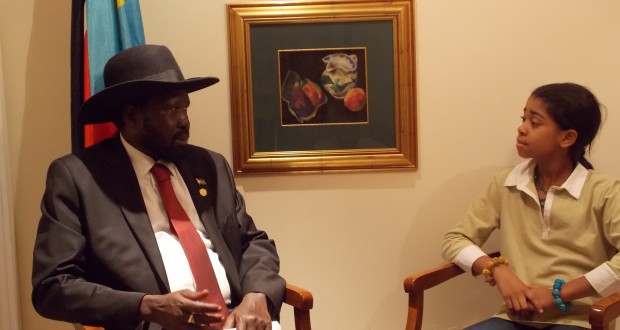 Ten year-old Nigerian girl Zuriel Oduwole has made history as the youngest person ever to be interviewed in Forbes, the global iconic magazine title.
The interview with the award winning documentary film maker, conference speaker and writer is featured in the August 2013 edition of Forbes Africa.
Touted by some as the next Larry King, and ARISE News at the next Oprah Winfrey, Oduwole is reportedly committed to Rebrand Africa by showing the positive things in about the continent, and making the case for education the Girl Child in Africa and Emerging Markets.
As an invited guest to the recent African Union 50th anniversary celebrations in Ethiopia, she has in her quest of pursuing her goal interviewed leading African business, political, and sports personalities, including eight current African Presidents, Africa’s richest person, Aliko Dangote and Tennis super stars – Venus and Serena Williams.
Zuriel (which is Hebrew for God is my Rock) believes if she can walk a mile, then there are girls who on seeing her work and progress made, would walk a mile and half.
That, she believes is one simple way to inspire the African Girl Child, and show the world the need to educate the continents often forgotten Girl Child, of which Zuriel is one.
Nigerian Presidential Debate - GEJ Making Lame Excuses
Nigeria is a bundle of contradictions - a fertile ground for eternal belief in democracy, where all hopes for democractic progress go to die. It has even been said in "respectable" quarters that the very nature of electioneering and democracy is alien to us. Some "respected" elders have postulated that Nigerians are governable only by someone with a "iron fist". Nevertheless, Nigeria and Nigerians have consistently chosen to partake in the the commity of nations and we have continued to forge along, tottering on unsteady legs, weaving and bobbing. A coup here, a civil there; an inept bunch of kleptomaniac robbing us blind here, an internecine warfare over there; bad, good and ugly, we have tried to carry on. We are nothing if not a resilient and stubborn bunch of people. We adapt. In the pursuit of a participatory system of governance. Hoping that, by trial-and-error, we will someday get it right.
And so it is that, in spite of several years of disappointments, infrastructural decay, run-away inflation and unspeakable level of unemployment, crime, lack of any semblance of social welfare, Nigerians are gearing up to go to the polls again in April and pull a lever for Democracy. An uninitiated observer may be tempted to wonder whether we are just a bunch of self-flagellating psychopath for trusting so much in the system that has continued to fail us on such a regular basis. Such a foreign observer will be missing a critical component of the Nigerian psyche - everlasting hope for a better "tomorrow".
We are hopeful. We are trusting. So, we hope that, this time, the preparation for (and outcome of) the April elections will be different and much better than in the past. We are in a more modern era now, after all. Things are moving around us all over the world. The world is changing. What with the "internet revolutions", what with all the entrenched "regime-for-life" governments falling down faster than you can say "Egypt!"? We are hopeful (and praying) that, this time, the people who would like to rule us will be paying attention. How could they not? They all have iPhones and Blackberries and access to the interwebs and other sources of information and they are witnessing (with their own korokoro eyes) how quickly events seemingly brewing in tiny tea cups turn into uncontrollable tsunami that sweeps away "strong men" like some useless jagbajantis.
We were hoping that, this time, things will be different. Our political aspirants will be better behaved. Since we are in modern times, we were hoping that they will step away from the rot of the past and chart a new, more progressive course in history. We were hoping that the violent rhetorics and histrionics of the past (you know, those deplorable accompaniments of Nigerian politicking of the past) will be dispenced with and they will stand up and strive to play politics as it is meant to be practiced in modern times. Like, for example, by engaging in things like a public debate of important and relevant issues of the day.
Our spirits were lifted a great deal when the Nigerian News Channel, NN24, announced (to a great fanfare) that all the Major Political Parties in Nigeria have agreed to participate in a couple of Vice-Presidential and Presidential debates before the April elections. NN24 even broadcasted a footage of the representatives of the Parties signing the so-called "Memorandum of Understanding". Finally, we thought, Nigeria is coming of age. It had earlier been reported that the current ruling party might not agree to participate in the debate. But, now we have video evidence. And we will get a chance to, at least, witness a critical part of a modern-day democracy in Nigeria. In the year 2011. Better late than never.
We were hoping. And then we had our hope dashed. By no other person than the (dis)honourable Director of Media and Publicity of the Presidential Campaign Council (PCC), Abah Daboh.
You see, Abah Daboh (and, apparently, his boss, President Goodluck Ebele Jonathan) have a bone of contention with the "modalities" of the proposed debate. And, God help them, that bone must be picked. In Mr. Daboh's (and President Jonathan's) views, a "Debate" that does not include ALL the official 18 "Presidential" contenders has no bona fide, and President GEJ will surely not have anything to do with it. All 18 of them must debate together, otherwise there will be no fairness in the debate, according to the Wizards of PDP and PCC. Haba! We are so, so, so close to tasting the "Forbidden Apple" of Nigerian politics - Politicians actually talking about issues to their constituents, and engaging in a public back-and-forth with their opponents in the public arena, on the same pedestal. And here comes Mr. Daboh to yank it away from hour hands.
Mr. President, let's accept that your objection is sincere and legitimate. HOW, sir, do you propose to stack up 18 contenders on the same stage for an intelligent debate of REAL ISSUES? The whole point of a political debate is to present critical and concise argument of a position or policy, have them questioned by others, and defend them when questioned. In the process, you explain to the electorate HOW and WHY what you are selling them is of better qualities than what your opponents are hawking. In general, you can expect that the whole debate will last between 90 minutes and two hours, tops.
Knowing the above, Mr. President, HOW do you propose to allot the 2 hours among 18 people, giving each of them sufficient amount of time to connect with the electorate? Mr. President, we would like to believe that you and your handlers know the difference between a debate and a speech or press conference. You don't just get to deliver a prepared statement and then walk off the stage in a debate. No. On the average, you can expect to questioned on, at least, four of the major parts of your policies and plans. And, yes, you will be EXPECTED to question your opponents, too. You will be expected to provide a "rebuttal", usually to a controversial statement or asserion about you or your position made by your opponent(s). And, you will be expected to do each of these in more than one sentence, usually between 30 seconds and one minute, depending on the technicality or complexity of the topic at hand
We know that you and your handlers are aware of all this. Because we are sure that they have seen one or more REAL Presidential Debates in modern era politics. What we don't know, and cannot fathom is HOW you and your handlers PROPOSE to do all of the above (and more) within the allotted time (anything longer than 2 hours, and your audience start to tune out, even if your co-debators hadn't started snoring on their feet).
We would like to ask Mr. Dabo and his cowering master:
With 18 ego-driven, self-important, larger-than-life Presidential aspirants, some of whom may be so enamoured of their own voice and importance that they will frequently forget to stop talking when required.
•How many minutes (sorry, seconds) do you propose that each speaker be given to talk?
•Would each be entitled to the same number of questions? Minutes? Responses? If not, why not?
•How many of the other 17 contenders are allowed to respond to the speaker, and how long should their response be?
•How many times is each of the 18 players allowed to speak out of turn (before being taken to Kirikiri)?
•How many times times can a question be asked of each contender?
•How long will the moderator(s) have to read each question? And, if the question is not clear, can it be repeated at the request of the speaker? Does this cut into the responder's allotted time, or is that time deducted from the Petroleum Funds?
We know that you reside in Aso rock, but we didn't know that you were all collectively and figuratively living under the rock. Apparently you are; otherwise, your handlers would have advised you against trying to cover your nakedness with this wet fig leave of an excuse. In all the Democratic countries the world over, there are always many aspirants to any elected office. Some do it for fun, some do it for the fame, some do it to write a book, others do it because they are crazy. Then you have the serious contenders; the VIABLE contenders. The ones whom everyone knows have a legitimate chance of actually making a good run for the office. Everywhere Political Debates happen in the world, prunning the chaff from the wheat has ALWAYS been an acceptable practice. It is even more especially necessary in a situation such as what we have here in Nigeria, with 18 people (a majority of whom 95% of the Nigerian populace have never heard of or seen) vying for the same position. Are you hoping to be conceal your nakedness and emptiness by surrounding yourself with as many warm bodies as possible on stage? That won't work, Mr. President.
You know that there will not be enough room, time, resource, or interest for a 18-person debating exercise. It is indeed sad that, of all the excuses that you could have made, this is the one that you chose to make. Your attempts to run away from selling yourself to the Nigerian people is selling you short, Mr. President. Nigerians deserve to see their country evolve and break with its sordid past. Having a semblance of normalcy and a sense of being a part of the modern democracies will go a long way towards bringing us ever closer to that evolution and goal. Refusing to partake in this debate for any reason will not speak well of you, Mr. President. Rather it will portray you as an insecure weakling whose only claim of success have been more through happenstance and accidents than by any measure of ability or capability.
And so it is that, in spite of several years of disappointments, infrastructural decay, run-away inflation and unspeakable level of unemployment, crime, lack of any semblance of social welfare, Nigerians are gearing up to go to the polls again in April and pull a lever for Democracy. An uninitiated observer may be tempted to wonder whether we are just a bunch of self-flagellating psychopath for trusting so much in the system that has continued to fail us on such a regular basis. Such a foreign observer will be missing a critical component of the Nigerian psyche - everlasting hope for a better "tomorrow".
We are hopeful. We are trusting. So, we hope that, this time, the preparation for (and outcome of) the April elections will be different and much better than in the past. We are in a more modern era now, after all. Things are moving around us all over the world. The world is changing. What with the "internet revolutions", what with all the entrenched "regime-for-life" governments falling down faster than you can say "Egypt!"? We are hopeful (and praying) that, this time, the people who would like to rule us will be paying attention. How could they not? They all have iPhones and Blackberries and access to the interwebs and other sources of information and they are witnessing (with their own korokoro eyes) how quickly events seemingly brewing in tiny tea cups turn into uncontrollable tsunami that sweeps away "strong men" like some useless jagbajantis.
We were hoping that, this time, things will be different. Our political aspirants will be better behaved. Since we are in modern times, we were hoping that they will step away from the rot of the past and chart a new, more progressive course in history. We were hoping that the violent rhetorics and histrionics of the past (you know, those deplorable accompaniments of Nigerian politicking of the past) will be dispenced with and they will stand up and strive to play politics as it is meant to be practiced in modern times. Like, for example, by engaging in things like a public debate of important and relevant issues of the day.
Our spirits were lifted a great deal when the Nigerian News Channel, NN24, announced (to a great fanfare) that all the Major Political Parties in Nigeria have agreed to participate in a couple of Vice-Presidential and Presidential debates before the April elections. NN24 even broadcasted a footage of the representatives of the Parties signing the so-called "Memorandum of Understanding". Finally, we thought, Nigeria is coming of age. It had earlier been reported that the current ruling party might not agree to participate in the debate. But, now we have video evidence. And we will get a chance to, at least, witness a critical part of a modern-day democracy in Nigeria. In the year 2011. Better late than never.
We were hoping. And then we had our hope dashed. By no other person than the (dis)honourable Director of Media and Publicity of the Presidential Campaign Council (PCC), Abah Daboh.
You see, Abah Daboh (and, apparently, his boss, President Goodluck Ebele Jonathan) have a bone of contention with the "modalities" of the proposed debate. And, God help them, that bone must be picked. In Mr. Daboh's (and President Jonathan's) views, a "Debate" that does not include ALL the official 18 "Presidential" contenders has no bona fide, and President GEJ will surely not have anything to do with it. All 18 of them must debate together, otherwise there will be no fairness in the debate, according to the Wizards of PDP and PCC. Haba! We are so, so, so close to tasting the "Forbidden Apple" of Nigerian politics - Politicians actually talking about issues to their constituents, and engaging in a public back-and-forth with their opponents in the public arena, on the same pedestal. And here comes Mr. Daboh to yank it away from hour hands.
Mr. President, let's accept that your objection is sincere and legitimate. HOW, sir, do you propose to stack up 18 contenders on the same stage for an intelligent debate of REAL ISSUES? The whole point of a political debate is to present critical and concise argument of a position or policy, have them questioned by others, and defend them when questioned. In the process, you explain to the electorate HOW and WHY what you are selling them is of better qualities than what your opponents are hawking. In general, you can expect that the whole debate will last between 90 minutes and two hours, tops.
Knowing the above, Mr. President, HOW do you propose to allot the 2 hours among 18 people, giving each of them sufficient amount of time to connect with the electorate? Mr. President, we would like to believe that you and your handlers know the difference between a debate and a speech or press conference. You don't just get to deliver a prepared statement and then walk off the stage in a debate. No. On the average, you can expect to questioned on, at least, four of the major parts of your policies and plans. And, yes, you will be EXPECTED to question your opponents, too. You will be expected to provide a "rebuttal", usually to a controversial statement or asserion about you or your position made by your opponent(s). And, you will be expected to do each of these in more than one sentence, usually between 30 seconds and one minute, depending on the technicality or complexity of the topic at hand
We know that you and your handlers are aware of all this. Because we are sure that they have seen one or more REAL Presidential Debates in modern era politics. What we don't know, and cannot fathom is HOW you and your handlers PROPOSE to do all of the above (and more) within the allotted time (anything longer than 2 hours, and your audience start to tune out, even if your co-debators hadn't started snoring on their feet).
We would like to ask Mr. Dabo and his cowering master:
With 18 ego-driven, self-important, larger-than-life Presidential aspirants, some of whom may be so enamoured of their own voice and importance that they will frequently forget to stop talking when required.
•How many minutes (sorry, seconds) do you propose that each speaker be given to talk?
•Would each be entitled to the same number of questions? Minutes? Responses? If not, why not?
•How many of the other 17 contenders are allowed to respond to the speaker, and how long should their response be?
•How many times is each of the 18 players allowed to speak out of turn (before being taken to Kirikiri)?
•How many times times can a question be asked of each contender?
•How long will the moderator(s) have to read each question? And, if the question is not clear, can it be repeated at the request of the speaker? Does this cut into the responder's allotted time, or is that time deducted from the Petroleum Funds?
We know that you reside in Aso rock, but we didn't know that you were all collectively and figuratively living under the rock. Apparently you are; otherwise, your handlers would have advised you against trying to cover your nakedness with this wet fig leave of an excuse. In all the Democratic countries the world over, there are always many aspirants to any elected office. Some do it for fun, some do it for the fame, some do it to write a book, others do it because they are crazy. Then you have the serious contenders; the VIABLE contenders. The ones whom everyone knows have a legitimate chance of actually making a good run for the office. Everywhere Political Debates happen in the world, prunning the chaff from the wheat has ALWAYS been an acceptable practice. It is even more especially necessary in a situation such as what we have here in Nigeria, with 18 people (a majority of whom 95% of the Nigerian populace have never heard of or seen) vying for the same position. Are you hoping to be conceal your nakedness and emptiness by surrounding yourself with as many warm bodies as possible on stage? That won't work, Mr. President.
You know that there will not be enough room, time, resource, or interest for a 18-person debating exercise. It is indeed sad that, of all the excuses that you could have made, this is the one that you chose to make. Your attempts to run away from selling yourself to the Nigerian people is selling you short, Mr. President. Nigerians deserve to see their country evolve and break with its sordid past. Having a semblance of normalcy and a sense of being a part of the modern democracies will go a long way towards bringing us ever closer to that evolution and goal. Refusing to partake in this debate for any reason will not speak well of you, Mr. President. Rather it will portray you as an insecure weakling whose only claim of success have been more through happenstance and accidents than by any measure of ability or capability.
Lagbaja Country with “Mumudom”

Thank you for sounding the alarm in a way that should make us reflect deeper. Mumu is not a condition I proudly proclaim. It was with a heavy heart that I came to this shocking realization that we are indeed a country of mumus. Harsh as it might sound, no other explanation would suffice. It is apparent that the "leaders" know that they would always get away with whatever incredible schemes they concoct because, amongst other reasons,
(a) the mumu people they "lead" are no different from their mumu "leaders" in character(b) the mumu people are gullible, superstitious and naive
(c) there are no consequences for criminal acts if you belong to the right group
(d) these mumus never demand accountability from their "leaders"
(e) the mumus expect their rulers to loot or would otherwise consider them foolish
Apologies for the seeming overgeneralization but the vast majority runs with this mumu mindset.
There is a limit to how much one can squeeze into a song before sounding less music than sermon. Please permit me to expatiate using your perimeter of "recent events in the past week or two".
For simplicity I would use a numbered list to analyze and highlight a few seemingly disparate but absurd mumurity examples and indicators.
1. 5 members trying to impeach a governor would make you think there are probably only 6 or 7 members of the House of Assembly. According to the assembly's website there are 31 members. For mumus, 5 out 31 constitutes a majority.
2. In the land of mumus you can make your own mace and confer it with automatic authority, elect a "new Speaker" and swear him in.
3. No single hospital in Nigeria to entrust the unfortunately injured member with. He had to be flown to the UK.
4. Flown abroad ... likely on tax payers' account
5. Treated ... likely on tax payers' account
6. Visited by officials... likely on tax payers' account (business or first class tickets?)
7. Nyesom Wike the Minister of State who led the visit was until recently the Governor's (Amaechi's) Chief of Staff. He was allegedly nominated for the Ministerial position by Governor Amaechi.
8. Shouldn't the mumus wonder how Nyesom Wike as Minister of State for Education found the time for this all important trip while abandoning his post in spite of the raging crisis in his ministry with the Academic staff union of Nigerian universities currently on strike? Well the mumu staff and students can rot in hell I guess.
9. Madam Patience would probably have "visited" too, if not for the noise such would generate. So for now, the victim suffers alone.
10. The erstwhile pontificating police boss of the State could not find the patient's prominent attacker for over a week.
11. Madam Patience having first denied any involvement in the crisis while verbally attacking Soyinka, eventually owns up "pouring out her grievances".
12. She owns up to a group of visiting Bishops who came on a peace making mission to find a lasting solution to the crisis in their region. Religion is always an easy scapegoat and tool of deception in mumudom.
13. Why would you even think that the Bishops would go back empty handed? Any "transport fare/thank-you-for-coming", if received, would have likely been financed on tax payers' account.
14. And why are we ranting about "tax payers"? Why are the tax payers not furious over the incessant misappropriation and misapplication of their hard earned contributions? The answer lies in the question... Aside from PAYE, how many are compliant in mumudom?
15. First a set of 5 Governors and 3 Deputy Governors (representing their respective Governors), left their duty posts for a solidarity visit with the embattled Governor of Rivers State... of course to the detriment of tax payers. (a) They were not on leave, but left urgent work and duties behind for the "emergency" solidarity visit. (b) Flight to and fro Port Harcourt of course likely on tax payers' account.
16. They were closely followed by a second set of 4 commiserating sympathetic Governors. Of course, again likely on tax payers' account.
17. Madam Patience's grievance, as she divulged to the visiting Bishops, started when Governor Amaechi refused to be governed by her, as he would not listen to her veiled orders on how to govern the State... which incidentally is her primary territory being her State of origin. Mumus have no problem with that, fully being in harmony with her as she sings as first lady in Abuja while simultaneously dancing in absentia as Permanent Secretary in Bayelsa and conducting the orchestra in home state, Rivers.
18. Madam ends her confession to the Bishops by saying that Amaechi is her son as she is obviously the mother of everyone in mumudom. The question all mumus should ask is, "Would a good mother promote the demise of her child?"
19. Where was her outraged sense of motherhood when Senators were busy voting to turn mumudom into a Nation of pedophiliacs at the expense of her innocent "daughters"?
20. Where was her outraged sense of "mother of the Nation" when the video of 5 gang rapists went viral. Has she used that "mother of the Nation" power to find the culprits? Not a priority in mumudom.
21. Where was her outraged "motherhood of mumudom" when 46 school children were murdered in Yobe? Indeed the whole Nation of mumus have just gone on with their more important mumu lives like nothing happened.
22. Which brings us to the insane mumurity that gives the "leaders" confidence to try pranks such as the attempt at crafting the under age marriage law, knowing that with the mumus... "nothing go happen"
23. In the land of mumus, the rulers know they can always throw in the religious card, so Senator Yerima leads the child slavery onslaught with the religious chant.
24. While all this was going on, 79 year old OPC founder, Dr. Fasheun was, in his own description, "delivering" Mustapha to Kano.
25. Soon after, Gumsu Sani Abacha had the courage to rant on social media about her proud heritage... because with the mumus who his father savagely ruled over... nothing go happen.
26. Gumsu even called Soyinka who was a victim of her beloved dad's misrule, "Mad empty Professor" ... because in mumudom, "nothing go happen".
27. Final scores... Jang 13, Amaechi 19, but in the land of mumus Mathematics has a different interpretation for 13 is greater than 19. Even the President of the mumus ratifies that.
28. By the way, both Governors Jang and Amaechi are from the same imploding political party.
29. Jang says he is old enough to be Amaechi's father... a common escape route that is often quickly bought by the mumu populace. Old enough to be the President's pawn and to upturn justice might be more like it. Only possible when you know for sure that your people are mumus... Nothing go happen.
30. The Governor is supposed to be the chief security officer of his State, but apparently in mumudom, his Police Commissioner is his boss.
31. The Governor's security staff could be so easily withdrawn because nothing is institutionalized in a Nation of mumus. The loyalty of the security personnel is not based on the constitution but on personal or maternal affiliations. The mumus keep watching because "it does not concern me o"... "Big men and women are fighting". Same way the injustice of the Nation's attorney general's assassination does not concern them.
32. Most reports in the Nigerian media kept referring to the self appointed Speaker as if he were truly the substantive Speaker. A mere use of "self-acclaimed" would have been logical, but they were already calling him the Speaker because... ignorance? inducement? resignation to the belief that the 5 vs 26 Assembly coup was already a done deal?
33. While all this drama unfolded, Nigeria, like the proverbial head-burying ostrich felt it had the moral right to insist on democratic processes in Egypt.
34. Sahara Reporters had screamed about the underhand conspiracy to proclaim Mustapha "not guilty". Mumus simply went about their daily mumurity unperturbed because "it doesn't concern them". And when it happened as predicted... no problem. Mumus continue dem jolly as if nothing happened.
35. Meanwhile, Daniel and his political supporters carried their politics into the house of God at Rueben Abati's mother's funeral service... simply because there is no true reverence for God. Religion is a safe hiding cave. The mumus in the congregation would never protest such sacrilege because... "it is not strange" as the houses of God are now also political grounds. Obasanjo built one in Abeokuta. Jonathan got one built in Otuoke.
36. Meanwhile, some other mumus were again busy putting the Nation to international shame. In unprecedented match fixing fiascos, Police Machine beat Bubayaro 67-0 while Plateau United Feeders beat Akurba FC 79-0. Just in case you are confused, the game was soccer, not basketball.
37. The matches were to determine which one of the two tied teams would be promoted into... wait for this... just the 3rd division of the Nigerian soccer league. How many goals would they have to orchestrate when they want promotion to the 1st division?
38. Interesting to note that one of the teams involved in these shows of shame, the Police Machine, represents the Police Force. Now who would investigate this scandal?
39. Mumus involved in the conspiracy had to include players... team management... referees and other match officials... spectators??? That is quite a large mumu cooperative.
40. Since four teams were involved, multiply the number of conspirators by 4 (except match officials and spectators which should be multiplied by "only" 2). Hence, the scam was done in the open. It was a confident public show of shame. No... two confident simultaneous scams. No problem as corruption is everywhere.
41. Before the matches, Police Machine and Plateau United were level on points, goal difference and goals scored, and each was playing its final match which would determine which team would get elevated into the 3rd division league. Plateau United scored 72 of its 79 goals in the second half, thereby averaging more than one goal per minute. This would necessarily include the time needed to celebrate each goal, retrieve the ball, bring it back to the center, wait for the referee's whistle before kicking off again.... after each goal. 72 times. Or did they just write the preferred figures as we typically do on election day?
42. Is it not curious that neither of the two losing teams could manage a single consolation goal? What else are we if not mumus?
43. Then there was the innocent man who was freed by the high court in Owerri after having been unjustly incarcerated for seven years, "awaiting trial". No compensation... nobody held accountable for his ordeal. He insisted on being taken back to the prison as that was his only guaranty of a roof over his head and a daily meal. It was merely a "small thing" in the daily bizarre news as mumus went about their daily mumurity with their typical mentality of "e no concern me".
44. Remember that this is mostly a snippet of the past two weeks or so. But there is more... 20 year old Chijioke Nwankor allegedly rapes a 9 year old pupil to death in Calabar. Reportedly in his own words, he asked her to bend down in the uncompleted building because it was too dirty to lie down as the place was being used as a public toilet. That is mumudom parlance for faeces shamelessly defecated all over the ground. Could the defecation be by aliens from outer space?
45. Well... thankfully, there is always a little ray of sunlight sneaking through the dark jungle. A Briton who was kidnapped by an armed gang shortly after arrival in Lagos, has been released.
...All in just the past two weeks or so in mumudom.
Excuse me, I have to return to work. I need to earn £3000 for my British visa. Wait a minute, did I tell you I am still a Commonwealth citizen?
Lágbájá
Subscribe to:
Posts (Atom)
